
Digital Classroom
Strings
Woodwinds
Brass
Percussion
Violin
Antonio Vivaldi: ‘Spring’ from The Four Seasons
Violin: (soprano of the string family) The vibrations caused by drawing the bow across the string reverberate against the sound post, a small wooden rod underneath the bridge, inside the violin. These vibrations are amplified and transferred within the violin to create its sound. The scroll at the top and the tailpiece are responsible for holding the strings in place. The vibrations of the strings can be adjusted by placing a rubber mute on the strings. This causes the characteristically clear and direct sound of the violin to be softer and less focused.
Viola
Max Bruch: Romance
Viola: (alto of the string family) The viola is mechanically similar to the violin in the way its sound is produced. The viola is 1-1 ½ inches longer and overall bigger than the violin, allowing for longer and thicker strings. This creates the lower sound of the viola as there is more length for further vibration. Like the violin, the viola is supported by the musician’s shoulder and held under the chin.
Cello
Robert Lopez and Kristen Anderson-Lopez: ‘Remember Me’ from Coco
Cello: (tenor/bass of the string family) The cello is also mechanically similar to the violin, with its main difference being its much larger size. As a result, the cello can not be held on a musician’s shoulder. Instead, it rests on the floor, supported by a metal rod called an endpin. Cello strings are tuned to the same pitches as viola strings – A, D, G, C – but at a lower octave.
Double Bass
Camille Saint-Saens: ‘The Elephant’ from The Carnival of the Animals
Double Bass: (bass/contrabass of the string family) The double bass is a modern, hybrid instrument as it includes mechanical elements from the violin and viola da gamba families to create its sound. From the violin family, the double bass has similar sound holes, scroll, and rounded back. From the da gamba family, the double bass gets its flat back and string tuning. While the double bass tunes its strings to the same pitches as the violin – E, A, D, G – the pitches are reversed, with the E string as the lowest pitch.
Flute
Sergei Prokofiev: Peter and the Wolf
Flute: The flute is made of three parts: the headjoint, body, and footjoint. Air is blown across and into the lip plate on the head joint. This air travels through the flute. Keys on the body and foot joint can be open and closed in specific patterns to create the sound desired and affect the tone of the notes produced. In addition to the flute, orchestral repertoire often includes the piccolo, which is a smaller version of the flute that plays an octave above the flute’s normal range.
Oboe
John Williams: theme from Star Wars
Oboe: The oboe is composed of three sections: the top joint, middle joint, and the bell. It is classified as a double reed instrument in reference to how the sound is produced. The double reed of an oboe is made with two thin pieces of cane bound together in a circular shape. When air is blown through the reed, these pieces of cane vibrate against each other to create a sound. The keys found along the entire instrument can be opened and closed to change the pitch of the sound produced. While the oboe functions as a soprano instrument, an alto double reed instrument called the English Horn is also featured in symphonic works.
Clarinet
John Powell: Theme from How to Train Your Dragon
Clarinet: A clarinet is composed of five parts: the mouthpiece, the barrel, the upper joint, the lower joint, and the funnel-shaped bell. Clarinets produce sound by using a single reed made of cane. When the reed is put into the mouthpiece, there is a small gap that the player blows air into between the reed and mouthpiece. This causes the tip of the reed to vibrate and create the sound of the clarinet. There are two types of clarinet that are commonly seen in the SSO: the b flat clarinet, which plays in the soprano/alto range, and the bass clarinet.
Bassoon
Nikolai Rimsky-Korsakov: Scheherazade
Bassoon: The bassoon is composed of five parts: a crook, the wing joint, the boot, the long joint, and the bell. The bassoon utilizes a double reed to create sound, but unlike the oboe, the reed for the bassoon is u-shaped. The reed is connected to the crook, which spans the length of the bassoon. When air is blown into the reed, it travels down the length of the crook to the bottom of the bassoon to the top. The player can change the pitch by opening and closing the keys in specific patterns. The bassoon plays music in the same range as the cello, and the closely-related contrabassoon has a range similar to the double bass.
Trumpet
John Williams: Theme from Star Wars
Trumpet: The trumpet is the smallest brass instrument in the orchestra. Its sound is created by the vibration of the player’s lips inside of the cup-like mouthpiece. The body of the instrument is comprised of valves, a bell, and coiled brass tubing which measures 4 feet and 10 inches long. The most common trumpet used in orchestral playing is a C trumpet, and the trumpet functions as the soprano member of the brass family. Trumpets are often found in jazz ensembles as well as in orchestras.
Horn
Wolfgang Amadeus Mozart: Horn Concerto No. 4
Horn: The French horn consists of a small circular brass body, a mouthpiece, valves, and bell. It produces sound in the same way as the trumpet. If the french horn were to be uncoiled and straightened, the brass tubing would measure over 12 feet long! This instrument has the widest range of the brass family, capable of playing pitches between A1 and F5. In order to create such a wide range of pitches, one hand controls the valves while the other hand rests inside the bell and adjusts its position to change the sound.
Trombone
Henry Fillmore: Lassus Trombone
Trombone: Like the other brass instruments, the trombone produces sound via the vibration of the player’s lips in the mouthpiece. However, unlike its counterparts, the trombone is a long instrument whose pitch is controlled by the movement of a slide. Moving the slide makes the instrument longer or shorter and changes the pitch in accordance with the length of the slide. Fully extended, the trombone is comprised of about 9 feet of tubing. The two most common types of trombones used in symphonic literature are the tenor trombone and the bass trombone.
Tuba
Original composition by SSO musician Carl Kleinsteuber
Tuba: While its mouthpiece and subsequent sound production function in the same way as the rest of the brass family, everything about the tuba is bigger. The largest of the brass family, the tuba is known for its low notes and loud presence. The tuba is approximately 18 feet in length when uncoiled. While tubas can be played while standing, such as for a marching band, tubas, due to their large size, are often played while seated.
Timpani
Timpani: Timpani (singular timpano) are large, single-sided drums. Instead of having two skins like snare drums, they instead have a large copper or brass base with material stretched across the top. Timpani are very sensitive instruments and the pitch can easily change in response to fluctuations in temperature and humidity. Timpani are low in pitch with a range of approximately one and a half octaves.
Xylophone
Koji Kondo: Theme from Super Mario Bros.
Xylophone: The xylophone is comprised of wooden bars in varying lengths that create different pitches. The wooden bars are arranged side-by-side, giving the instrument an appearance similar to that of a keyboard instrument. When struck with mallets, the wooden bars create a soft, ringing sound. The average range of a xylophone is 3 to 3½ octaves.
Glockenspiel
John Williams: Hedwig’s Theme
Glockenspiel: Similar to the xylophone, the Glockenspiel consists of metal bars arranged in the same way as a piano’s keys. Originally a substitute for bells, the Glockenspiel became very popular and was maintained as a distinctive instrument. This small and high-pitched metal instrument has an average range of 2½ octaves.
Snare Drum
Snare Drum: The snare drum is a small drum that is significantly wider than it is tall, with two skins, one on each side, called vellum. The distinct sound of the snare drum comes from the 8-18 strings that are found under the skin of the instrument. When tightened by pressing a pedal, these strings give the instrument a striking staccato sound. The snare drum’s characteristic sound can be found in both band and orchestral literature.
Meet the Symphony: Instrument Families
How does each instrument sound? What are they made of?
Meet the Symphony is a series of engaging videos and curriculum resources that introduce students to the instruments of the orchestra. Each 20–30 minute video explores one instrument family, featuring individual demonstrations, family performances, and clear explanations of how each instrument creates sound.
Created to answer these questions—and more—this virtual educational program includes four videos (about 25 minutes each) and adaptable lesson materials for classroom discussions, group projects, or independent learning. Led by Maestro Dominick, musicians share how their instruments work and talk about their musical journeys.
Lesson Plans
Designed to correspond with each Meet the Symphony video, the following content includes comprehension assessments, discussion points, and creative activities that may be completed in groups or individually. Each curriculum piece is designed to be utilized over the course of four to five class periods, and may be modified to suit the class time available.
Classroom Activity: What Do You Know?
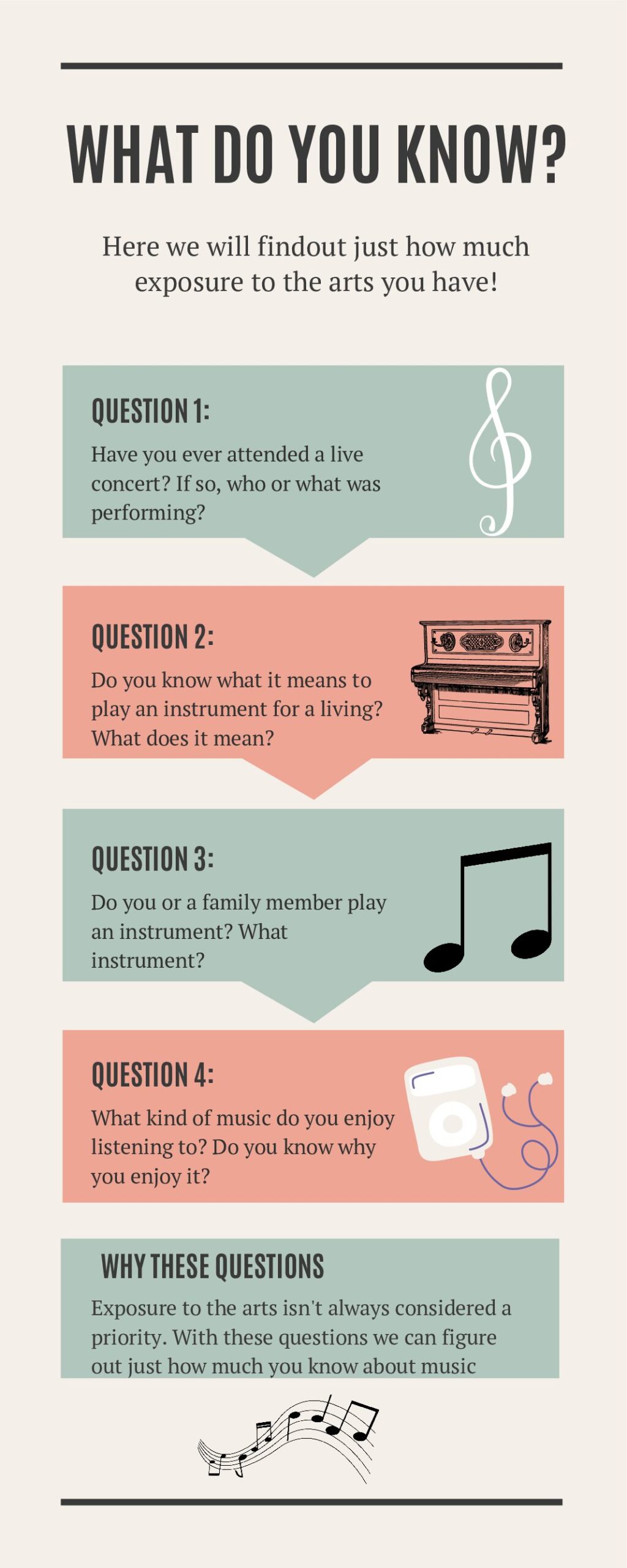
What Do You Know? takes students from the known to the unknown. This infographic is used to gauge how much exposure to the arts that students have received outside of class. This can be used with all of the materials on the SSO site.
Why these questions?
Exposure to the arts isn’t always considered a priority. With these questions we can figure out just how much you know about music.
- Have you ever attended a live concert? If so, who or what was performing?
- Do you know what it means to play an instrument for a living? What does it mean?
- Do you or a family member play an instrument? What instrument?
- What kind of music do you enjoy listening to? Do you know why you enjoy it?
Classroom Activity: Talk Like a Musician
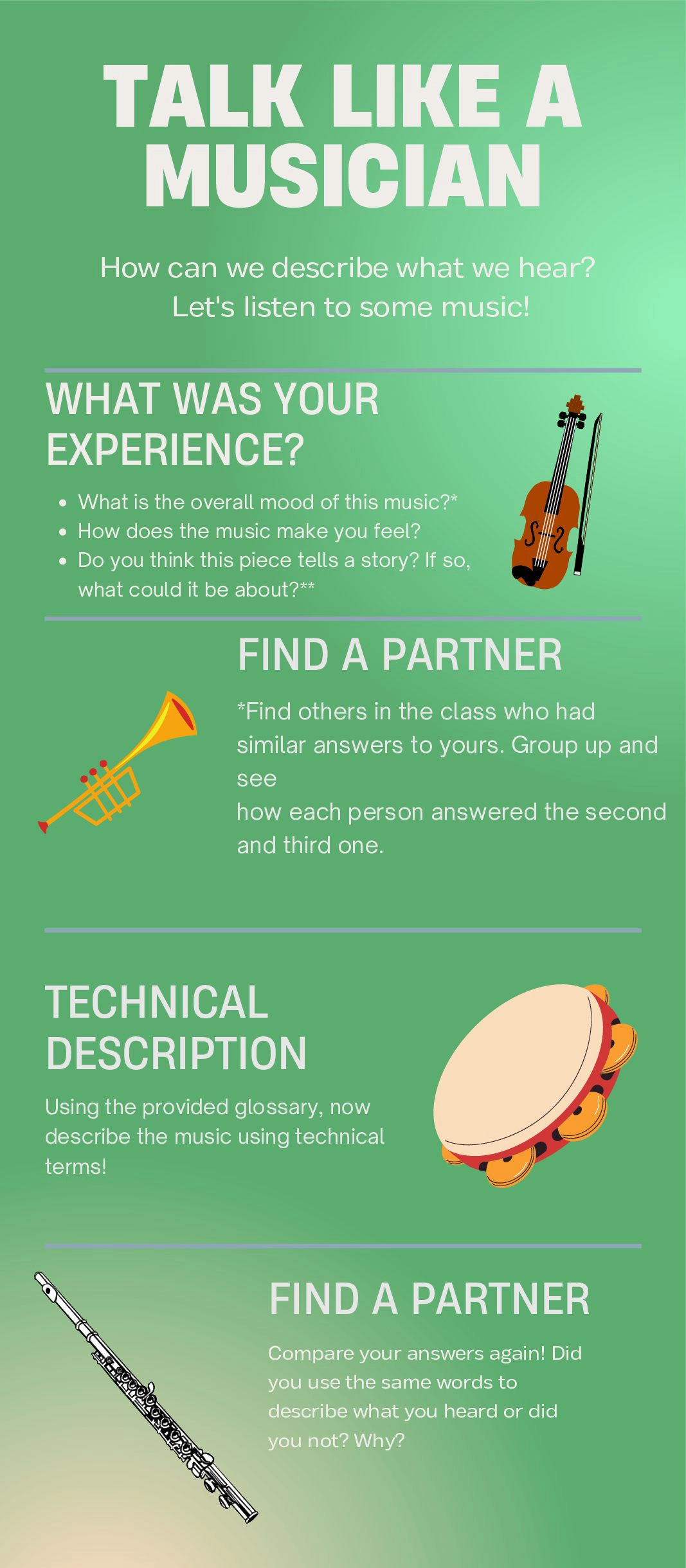
Talk Like a Musician invites students to listen to a piece of music and describe what they hear. This activity can be supplemented with the Kahoot! Music Vocabulary games linked below.
What was your experience?
– What is the overall mood of this music?
– How does the music make you feel?
– Do you think this piece tells a story? If so, what could it be about?
Find a partner:
Find others in the class who had similar answers to yours. See how each person answered the second and third one.
Technical Description:
Using the provided glossary, now describe the music using technical terms!
With your partner:
Compare your answers again! Did you use the same words to describe what you heard, or did you not? Why?
Instrument Trivia
This Kahoot! can be used in conjunction with Meet the Symphony videos or on its own. It teaches students about the instrument families, which instruments can be found in the SSO, and a few fun facts and videos of what certain instruments sound like.
Below is a printable worksheet that corresponds with Meet the Symphony activities:
Music Vocabulary
The two different versions of this Kahoot! contain technical, musical terminology:
Kahoot! Music Vocabulary – Advanced
This quizlet can be used to play matching games or as a gradable measure with the quiz feature included in quizlet:
Follow SSOEducation on Kahoot! for games about instruments, musical terms, and more. If you don’t have an account, you can play these games as a guest.